


Lenormand Like a Detective: The Case File Method 🕵️♀️🗂️

A practical way to turn “random cards” into a clear, confident answer.
If you ever pull a spread and think, “Okay… I see the words, but what is the story?”, this post is for you.
Today I’m showing you my Case File Method for Lenormand. It’s a simple structure that makes your readings feel less like guessing and more like investigating. You are not here to memorize 36 meanings like you’re cramming for a test. You are here to read what’s on the table like evidence.
Let’s open the file.
Step 1: Case Intake (Ask a Question That Can Be Answered)
Lenormand loves real questions. Not vague cosmic fog questions.
Upgrade your questions like this:
Too foggy: “What’s coming for me in love?”Better: “What do I need to know about my love life in the next 30 days?”
Too foggy: “How does he feel about me?”Better: “What is his current attitude toward me, and what action is he likely to take next?”
Too foggy: “Should I take the job?”Better: “What happens if I accept this job offer, and what happens if I decline it?”
Rule of thumb:If your question has a timeframe and a clear focus, Lenormand will answer like a champ.
Step 2: The Cast List (Who Are We Talking About?)
In a detective story, you don’t just stare at the clues. You identify the people first.
Quick “cast” cheat notes:
Man / Woman can be literal people or the main energies in the situation.
Child can be a literal child, a new beginning, or something small and developing.
Dog often shows loyalty, friends, allies, supportive people.
Fox often shows self interest, strategy, a “watch your back” vibe.
Snake can be another person, complication, jealousy, or a slow entanglement.
Detective tip:If you pull a people card, check what touches it. The cards next to a person are basically their behavior, mood, or role.
Step 3: Set the Scene (What Area of Life Is This Really About?)
Sometimes the question says “love” but the cards scream “money stress” or “work drama.”
Scene setting cards often include:
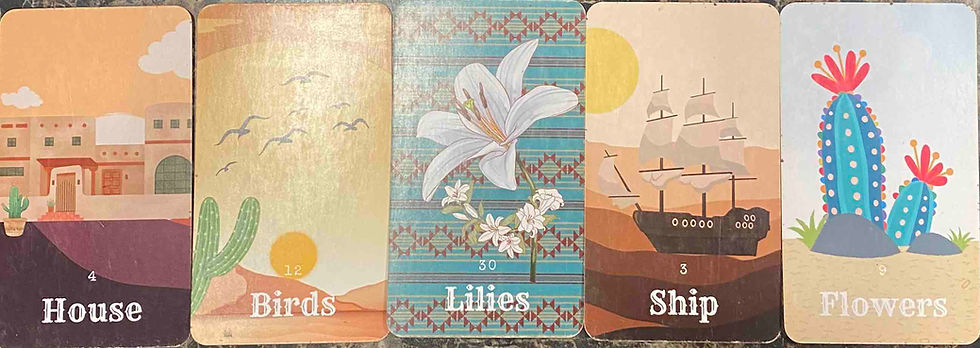
House: home, family, personal life, stability
Garden: social circle, public, groups, online spaces
Tower: institutions, work structure, distance, solitude, “boundaries”
Tree: health, long term growth, roots
Clover: luck, small opportunities, short term openings
Anchor: work, stability, long term security
Your job is to figure out the stage the story is happening on.
Step 4: Evidence Tags (This Is the Whole Method)
Here’s the magic part. Instead of trying to read all the cards at once, you label them.
Tag your cards like this:
Action cards (something moves, happens, is done):Rider, Ship, Birds, Scythe, Whip, Coffin, Letter, Roads, Stork
Environment cards (the vibe, location, context):House, Garden, Tower, Mountain, Clouds, Tree, Stars, Moon
Complication cards (the twist, the “uh oh”, the snag):Fox, Snake, Mice, Clouds, Mountain, Whip, Cross
Outcome cards (where it lands, the result):Ring, Key, Anchor, Sun, Heart, Cross, Coffin, Bouquet
You can absolutely disagree with a tag sometimes. The point is structure, not perfection.
Step 5: Motive (Why Is This Happening?)
Motive is the emotional engine or hidden driver.
Ask:
What card shows desire?
What card shows fear?
What card shows pressure?
What card shows strategy?
Examples:
Heart motive: feelings, attachment, softness
Fox motive: self interest, survival mode, playing it smart
Cross motive: duty, burden, spiritual lesson, “this is heavy”
Whip motive: tension, conflict, obsession, repeated cycles
Key motive: clarity, solution, inevitability
Motive explains why the story is unfolding the way it is.
Step 6: Timeline (When and How Fast?)
Lenormand does not always give an exact date, but it gives timing clues.
Timing hints:
Rider: fast, news soon, quick movement
Birds: quick, days, lots of chatter, nervous energy
Clover: soon and short lived
Ship: slower, distance, gradual progress
Tree: slow, long term, health or growth pace
Mountain: delays, obstacles, “not yet”
Stork: change over time, transition period
Detective tip:If you want timing, ask for it directly in the question. “In the next 2 weeks” is a great container.
Mini Case Studies (So You Can See It In Action) 🔎
Case 1: “Did they ghost me or just get overwhelmed?”
Cards: Clouds + Birds + Tower
Scene: Tower, this is distance, boundaries, isolation, or someone pulling back.
Action: Birds- Communication, nervous chatter, overthinking, talking about it but not doing it.
Complication: Clouds- Confusion, mixed signals, mental fog, uncertainty.
Outcome: Tower- They stay distant or they keep things contained, not emotionally open.
Verdict: This looks like overwhelm and confusion that results in emotional distance. Not warm, not clear, not consistent. Even if they are thinking about you, they are staying in their own space instead of showing up.
Advice: Ask a direct question or set a boundary. No chasing the fog.
Case 2: “Is this job opportunity real or a time-waster?”
Cards: Fox + Letter + Mice
Scene: Letter, Messages, contracts, emails, paperwork.
Action: Letter- The action is communication and documents.
Complication: Fox- Be smart. Something is strategic, salesy, or self interested.
Outcome: Mice- Loss, stress, things being chipped away, anxiety, “this drains you.”
Verdict: This looks like something that sounds good on paper but ends up costing you time, energy, or money. Could be misleading info, vague terms, or a role that slowly drains you.
Advice: Get everything in writing. Ask detailed questions. If they dodge, you have your answer.
Case 3: “Should I keep dating this person?”
Cards: Heart + Snake + Roads
Scene: Crossroads, Choices, crossroads, splitting paths.
Action: Crossroads- Decision time.
Complication: Snake- Complication, entanglement, mixed motives, slow unfolding issue.
Outcome: Crossroads- You end up choosing, or the connection stays in “uncertain” mode until you choose.
Verdict: There are real feelings here, but there is also a complication that will keep you stuck unless you make a clear choice. This can be a third party vibe, inconsistent behavior, or a situation that twists around itself.
Advice: Ask what the Snake represents in this situation. Then decide with your eyes open.
Common Pitfalls (So You Don’t Scare Yourself) 😅
Seeing one “hard” card and panicking. Cross, Coffin, Scythe, Whip are not automatic doom. They are pressure, endings, quick cuts, tension. Context decides.
Reading the cards like Tarot. Lenormand is literal and practical. Think nouns and verbs, not long archetypal essays.
Forgetting the question. Always bring it back to the case: what was asked, and what is being answered?
Lenormand reads easiest when you treat your spread like a case file: identify the cast, set the scene, tag the evidence, find the motive, then deliver a verdict in plain English.

Comments